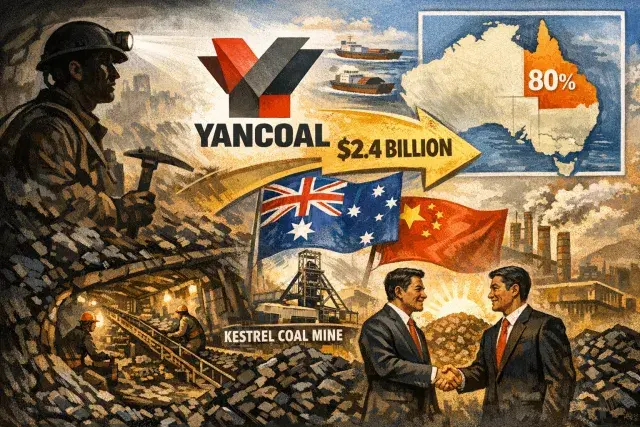
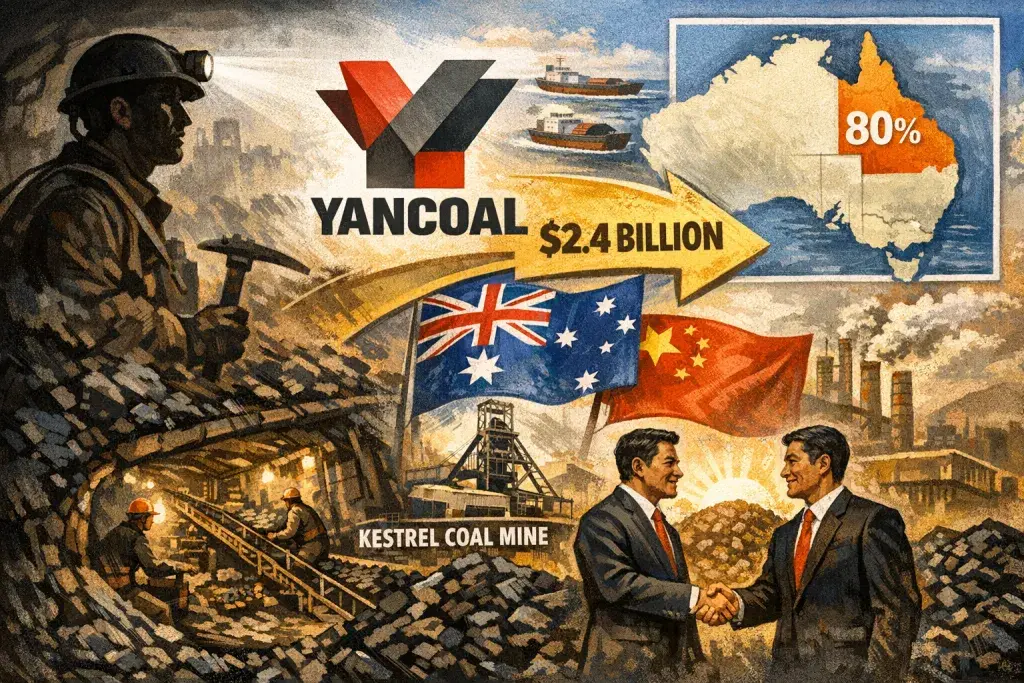
Yancoal Australia has agreed to purchase an 80% stake in the Kestrel Coal Mine in Queensland for up to $2.4 billion, securing control of Australia's largest active underground coal mine in one of the most significant coal transactions the country has seen in years. The deal, struck with a consortium of EMR Capital, Kestrel Coal, and Adaro Capital, positions the Chinese state-backed miner as the dominant force in a high-output metallurgical coal asset with roughly 25 years of productive life remaining. Japan's Mitsui retains the remaining 20% interest.
The Structure of the Deal
Yancoal will pay $1.85 billion upfront in cash, with an additional $550 million in milestone-based payments spread across the next five years. That deferred component ties a meaningful portion of the purchase price to performance conditions — a structure increasingly common in large resource acquisitions, where commodity price volatility makes fixed valuations risky for both sides.
Yancoal Australia is a listed entity on the Australian Securities Exchange but operates as a subsidiary of Yankuang Energy, a coal producer majority-owned by the Chinese state. The acquisition is therefore, in practical terms, an expansion of Chinese state-controlled interests in Australian coal infrastructure — a detail that carries weight given the geopolitical sensitivities that have defined the Australia-China trade relationship over recent years.
What Kestrel Represents
The Kestrel Mine sits in Queensland's Bowen Basin, a region that holds some of the world's most sought-after deposits of hard coking coal — the variety used in steelmaking, as distinct from the thermal coal burned in power stations. The mine produced 5.9 million tonnes of coal in 2025 and has a projected operational life extending another 25 years, making it an unusually long-duration asset in an industry where resource depletion and regulatory uncertainty often compress investment horizons.
Its customer base reflects the enduring demand for metallurgical coal across Asia's industrial economies. Sales flow primarily to buyers in Japan, South Korea, India, and Southeast Asia — markets where steel production remains central to infrastructure development and where domestic coking coal resources are either limited or lower in quality. For Yancoal, controlling Kestrel's output gives it direct leverage over supply chains feeding some of the world's most active steelmaking regions.
The Diplomatic Backdrop
The timing of the deal is not incidental. Australia and China have spent several years rebuilding a trade relationship that deteriorated sharply after 2020, when Beijing imposed a series of restrictions on Australian exports — including coal, wine, barley, and beef — in response to Australian government decisions that drew Chinese displeasure. The informal ban on Australian coal was among the most economically significant of those restrictions.
Relations have since recovered incrementally. Earlier this week, separate reporting indicated that China had approved the purchase of additional iron ore cargoes from BHP, another signal that the commodity trade corridor between the two countries is reopening with some deliberateness. Yancoal's Kestrel acquisition fits within this broader pattern: Chinese capital is re-entering Australian resource assets at scale, and doing so through commercially structured deals that carry institutional legitimacy on both sides.
What the Acquisition Signals for the Coal Sector
The deal arrives at a moment when the long-term outlook for coal remains contested but the near-term economics remain robust, particularly for metallurgical grades. Thermal coal demand faces sustained pressure from the energy transition, but coking coal occupies a different position: no commercially viable alternative to coal-based blast furnace steelmaking has yet been deployed at industrial scale globally, and the steel-hungry economies of South and Southeast Asia are unlikely to pivot quickly.
For Yancoal, the acquisition deepens its presence in Australia at a time when its parent company Yankuang Energy has been expanding internationally. For EMR Capital and its partners, the sale crystallises returns on an asset they acquired from Rio Tinto in 2018 for approximately $2.25 billion — a transaction that itself reflected the major miners' strategic retreat from pure coal exposure. The fact that Kestrel is now changing hands again, at a comparable or higher valuation, suggests the market for premium coking coal assets remains resilient despite the broader pressure on the sector's social licence.